Web Defacement Artifacts on Bangladesh Government Infrastructure Potentially Linked to Global Magento Exploitation Campaign
Published on 03-May-2026 16:00:00
Executive Summary
Cyber Threat Intelligence Unit of BGD e-Gov CIRT has identified multiple Bangladesh government web domains hosting suspicious artifact files such as gc.txt and uname.txt in publicly accessible directories. These files are commonly used by threat actors to verify unauthorized write access to web servers and claim defacement activities.
The observed artifacts coincide with indicators associated with a large-scale global web defacement campaign targeting Magento infrastructure, first reported on 27 February 2026. The campaign has resulted in the compromise of more than 15,000 hostnames across approximately 7,500 domains worldwide.
Technical analysis suggests attackers may be exploiting unauthenticated file upload vulnerabilities or remote code execution flaws in vulnerable web applications, allowing arbitrary files to be written to web directories. Although attribution remains unconfirmed, the observed artifacts match patterns reported in the global campaign where attackers uploaded plaintext files and subsequently reported compromised sites to public defacement archives.
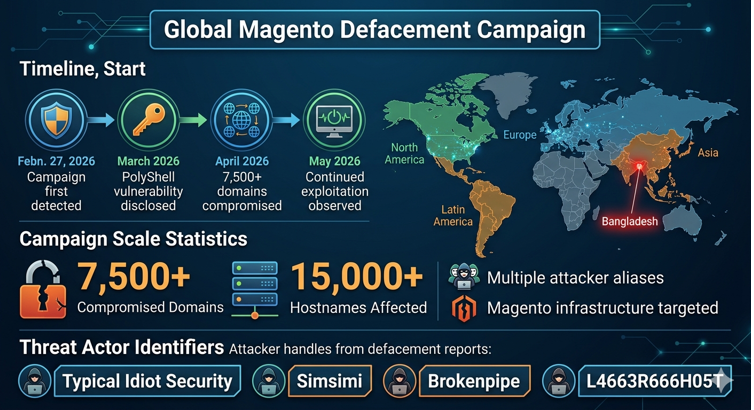
Figure: Global Distribution of the Magento Defacement Campaign
Observed Indicators in Bangladesh
Threat intelligence monitoring detected several government infrastructure endpoints hosting unauthorized files.
Artifact
https://***cpanel.***.gov.bd/gc.txt : Defacement claim file
https://portal.*******.gov.bd/gc.txt : Defacement artifact
http://server***.*******.gov.bd/gc.txt : Defacement artifact
http://****.gov.bd/uname.txt : System verification artifact
https://****.gov.bd/uname.txt : System verification artifact
Observed Artifact Behavior: These files typically contain:
· attacker handles or aliases
· timestamps
· proof-of-compromise text
· server verification output
Such artifacts are often used by attackers to:
· confirm successful exploitation
· demonstrate file system write access
· provide evidence for submission to defacement archives such as Zone-H
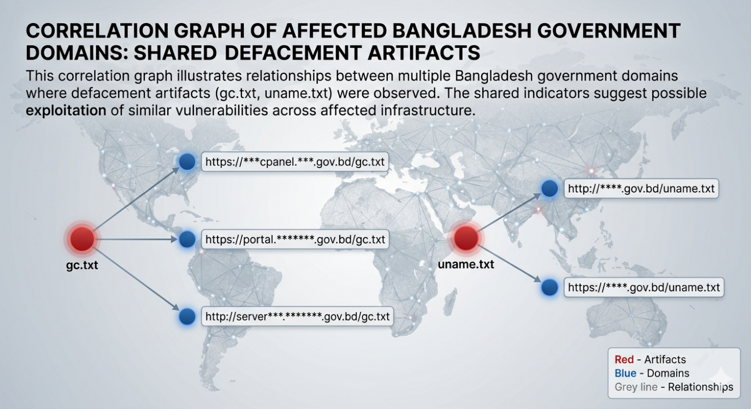
Figure: Correlation Graph of Web Defacement Artifacts Across Bangladesh Government Domains
Global Threat Context
Security researchers have documented a large-scale defacement campaign targeting Magento servers globally. Most defacements were reported to Zone-H, suggesting reputation-building activity within the defacement community. Key campaign characteristics include:
· compromise of 7,500+ domains
· more than 15,000 affected hostnames
· exploitation of vulnerable Magento REST API endpoints
· plaintext defacement artifacts uploaded to web directories
Threat actors involved in the campaign have used aliases including:
· Typical Idiot Security
· L4663R666H05T
· Simsimi
· Brokenpipe
Technical Root Cause Analysis
PolyShell Vulnerability (APSB25-94): The campaign has been linked to the PolyShell vulnerability, affecting Magento Open Source and Adobe Commerce.
Vulnerability Type: Unauthenticated Arbitrary File Upload
Affected Component: Magento REST API file upload functionality
Attack Mechanism: The vulnerability allows attackers to upload files encoded in base64 format through REST API endpoints without proper validation.
Example attack workflow:
POST /rest/V1/products
Content-Type: application/json
Malicious payload example:
{
"file": "base64_encoded_payload"
}
If server-side validation is misconfigured, the uploaded payload can be written to the filesystem.
Potential Outcome:
· Arbitrary file upload
· Web shell deployment
· Remote code execution
· Full server compromise
SessionReaper Vulnerability (CVE-2025-54236): Another vulnerability observed in similar campaigns is SessionReaper, a critical Magento RCE flaw.
CVSS Score: 9.1 (Critical)
Vulnerable Endpoint: /customer/address_file/upload
Exploitation Mechanism: The vulnerability exploits nested deserialization flaws, allowing attackers to execute arbitrary code via crafted payloads.
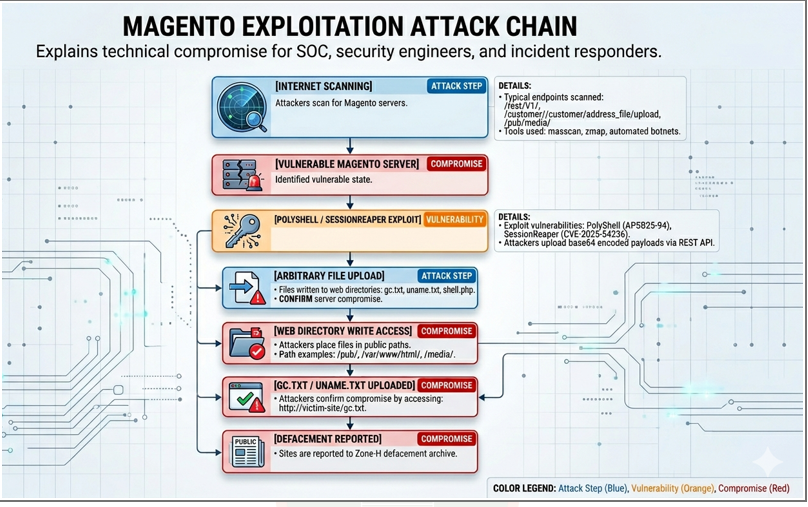
Attack Chain Reconstruction
The attack pattern observed in the global campaign typically follows the sequence below.
Stage 1 — Internet-wide Scanning:
Attackers scan for vulnerable Magento installations. Common scanning targets:
· /rest/V1/ [Magento REST API]
· /customer/address_file/upload [File upload endpoint]
· /pub/media/ [Public media directory]
Stage 2 — Exploitation:
Attackers send crafted requests exploiting file upload vulnerabilities. Possible uploaded files include:
· web shells
· PHP backdoors
· plaintext defacement artifacts
Stage 3 — Filesystem Write Access:
Attackers upload files such as: (These files are stored in publicly accessible directories.)
· gc.txt
· uname.txt
· shell.php
Stage 4 — Proof of Compromise:
Attackers verify access by retrieving uploaded artifacts through HTTP requests.
Example: GET /gc.txt
Stage 5 — Public Defacement Claim:
The attacker reports the compromised domain to Zone-H or similar defacement archives.
 Potential Impact
If exploitation is confirmed, attackers may gain:
· persistent web server access
· ability to upload additional payloads
· access to sensitive application data
· ability to modify web content
Possible consequences include:
· website defacement
· customer data exposure
· payment card skimming
· malware hosting