FortiBleed Campaign Exposes FortiGate Devices in Bangladesh with Credential Compromise
Published on 07-Jul-2026 15:30:00
Executive Summary
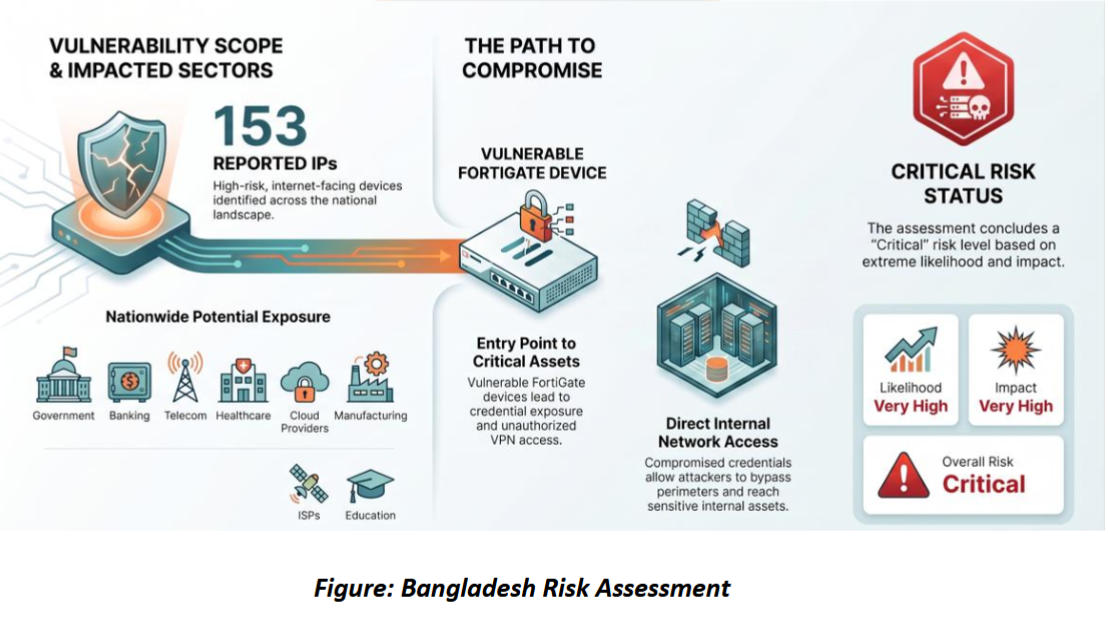
BGD e-GOV CIRT has identified 153 unique Bangladesh IP addresses associated with the ongoing FortiBleed campaign affecting internet-facing Fortinet FortiGate security appliances. The affected systems have been reported with the "fortibleed" tag, indicating potential exposure to credential theft and unauthorized access resulting from exploitation of FortiGate vulnerabilities.
The campaign targets FortiGate SSL-VPN and management interfaces to obtain sensitive information, including user credentials, session data, authentication tokens, and Active Directory-related artifacts. Analysis conducted by multiple cybersecurity organizations indicates that attackers are actively harvesting credentials from vulnerable FortiGate appliances and leveraging the stolen information to gain persistent access into enterprise networks.
Organizations operating FortiGate devices should immediately verify whether their systems are affected, rotate all credentials associated with FortiGate appliances, review authentication logs, and investigate for evidence of unauthorized access.
FortiBleed Campaign Overview
The FortiBleed campaign represents an active large-scale credential compromise operation targeting internet-facing Fortinet FortiGate appliances. Threat intelligence indicates that attackers are exploiting compromised or previously vulnerable FortiGate systems to obtain authentication material and maintain persistent access to enterprise environments.
Unlike traditional remote code execution campaigns, FortiBleed primarily focuses on the exfiltration and operational reuse of authentication artifacts rather than immediate payload deployment. Harvested credentials enable attackers to bypass perimeter defenses and authenticate as legitimate users through FortiGate SSL-VPN services.
The campaign has been observed globally, affecting organizations across 194 countries, with 153 publicly exposed FortiGate devices identified in Bangladesh requiring immediate investigation.
Technical Attack Lifecycle
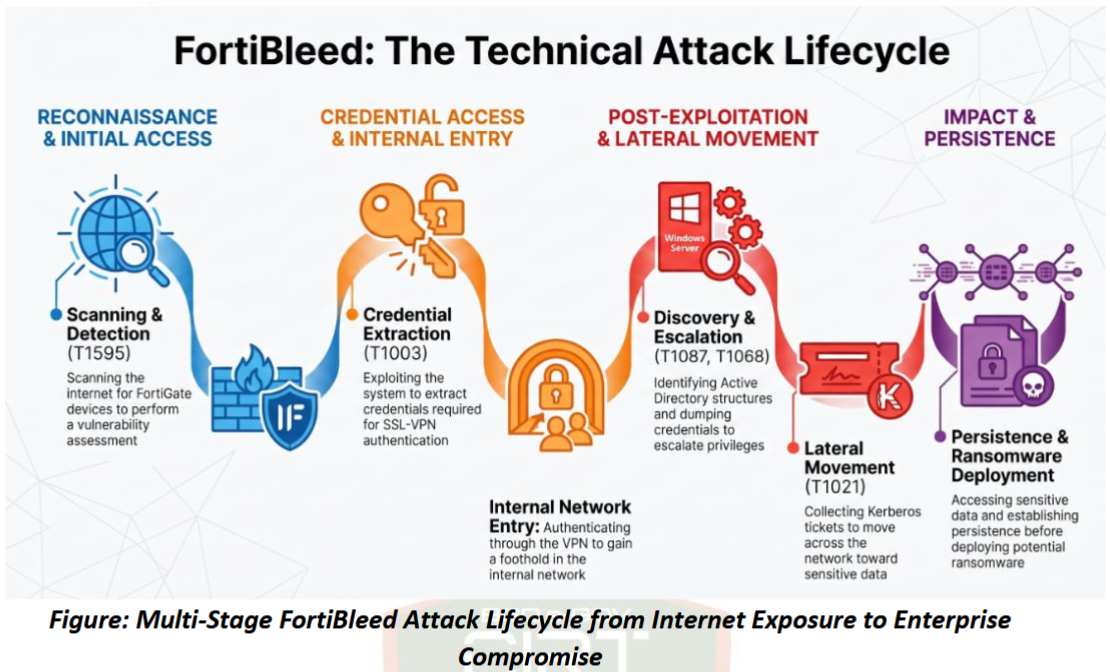
The observed FortiBleed campaign follows a multi-stage intrusion model.
Initial Reconnaissance
Threat actors continuously perform Internet-wide reconnaissance to identify exposed FortiGate appliances.
Reconnaissance typically includes:
· SSL-VPN portal enumeration
· Administrative interface discovery
· FortiOS version fingerprinting
· Certificate enumeration
· Banner grabbing
· Internet-wide scanning using automated frameworks
During this phase, attackers identify devices susceptible to credential extraction or devices that may have previously been compromised.
MITRE ATT&CK
· T1595 Active Scanning
· T1590 Gather Victim Network Information
Authentication Artifact Collection
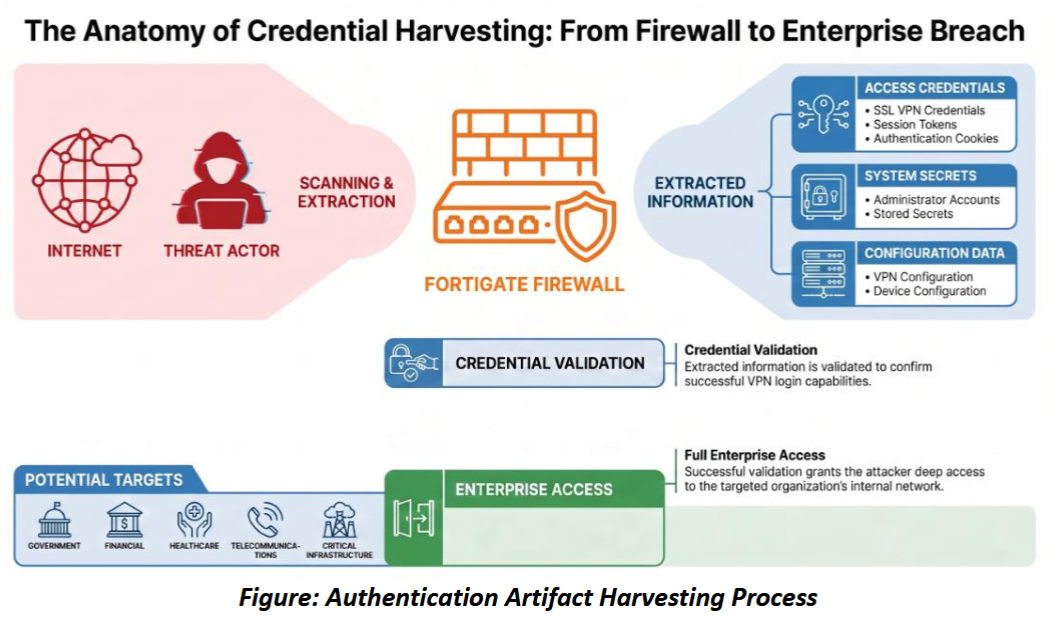
The primary objective of FortiBleed is the acquisition of authentication material stored within FortiGate appliances.
Potentially exposed information includes:
· SSL-VPN usernames
· Passwords
· Session cookies
· Authentication tokens
· Device configuration
· VPN configuration
· Administrative credentials
· User session information
· Authentication cache
Once extracted, attackers validate harvested credentials against exposed SSL-VPN gateways.
Unlike brute-force attacks, authentication occurs using legitimate credentials, significantly reducing detection opportunities.
SSL-VPN Session Hijacking
Compromised authentication artifacts may allow attackers to hijack active VPN sessions.
· Observed techniques include:
· Session cookie replay
· Authentication token reuse
· VPN credential replay
· Session impersonation
If Multi-Factor Authentication (MFA) is enforced only during initial authentication, possession of valid session identifiers may permit continued access without requiring additional user interaction.
Potential consequences include:
· Remote access to internal networks
· Persistent VPN connectivity
· Stealthy post-compromise operations
· Access to sensitive applications.
Internal Network Reconnaissance
Following successful authentication, attackers initiate reconnaissance activities designed to understand the internal enterprise environment.
Common objectives include:
Active Directory Discovery
· nltest
· net group
· net user
· net view
· dsquery
· dapsearch
Network Discovery
· Domain Controllers
· File Servers
· Backup Servers
· Hypervisors
· Database Servers
· Exchange Servers
Administrative Discovery
· Local Administrators
· Domain Admins
· Enterprise Admins
· Service Accounts
· Privileged Groups
MITRE
· T1018 Remote System Discovery
· T1087 Account Discovery
· T1482 Domain Trust Discovery
Credential Access and Kerberos Exposure
Once inside the enterprise network, attackers frequently transition toward credential acquisition.
Common techniques include:
LSASS Memory Dumping: (lsass.exe)
Credential dumping utilities:
· Mimikatz
· ProcDump
· NanoDump
Privilege Escalation
Attackers attempt to obtain administrative privileges using:
· Cached Administrator Credentials
· Weak Service Account Passwords
· Kerberoasted Accounts
· Misconfigured ACLs
· Token Impersonation
Successful privilege escalation significantly expands the attack surface.
Lateral Movement
Observed enterprise pivot techniques include:
· RDP
· SMB
· PsExec
· WinRM
· Remote PowerShell
· WMI
· Scheduled Tasks
· Remote Services
Potential Ransomware Deployment
Although FortiBleed primarily represents a credential compromise campaign, compromised VPN credentials are commonly leveraged by ransomware operators.
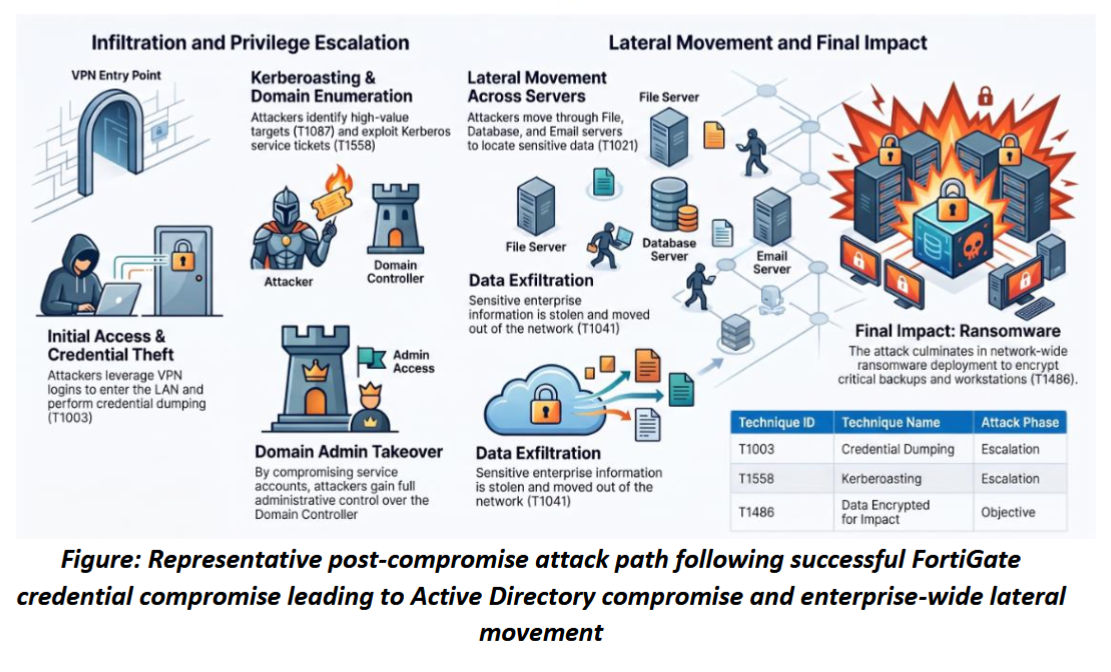
Typical post-compromise sequence
- Credential Theft
2. Domain Enumeration
3. Privilege Escalation
4. Backup Discovery
5. Security Tool Disablement
6. Data Exfiltration
7. Ransomware Deployment
This attack chain closely resembles recent campaigns conducted by: Akira, LockBit, INC, Play, Black Basta.
Behavioral Indicators
· Unexpected VPN logins
· Geographic login anomalies
· Privileged account misuse
· Rapid authentication followed by internal reconnaissance
· Active Directory enumeration
· Kerberos ticket harvesting
· Password spraying
· Credential stuffing
· Remote administrative tool execution
Detection and Monitoring
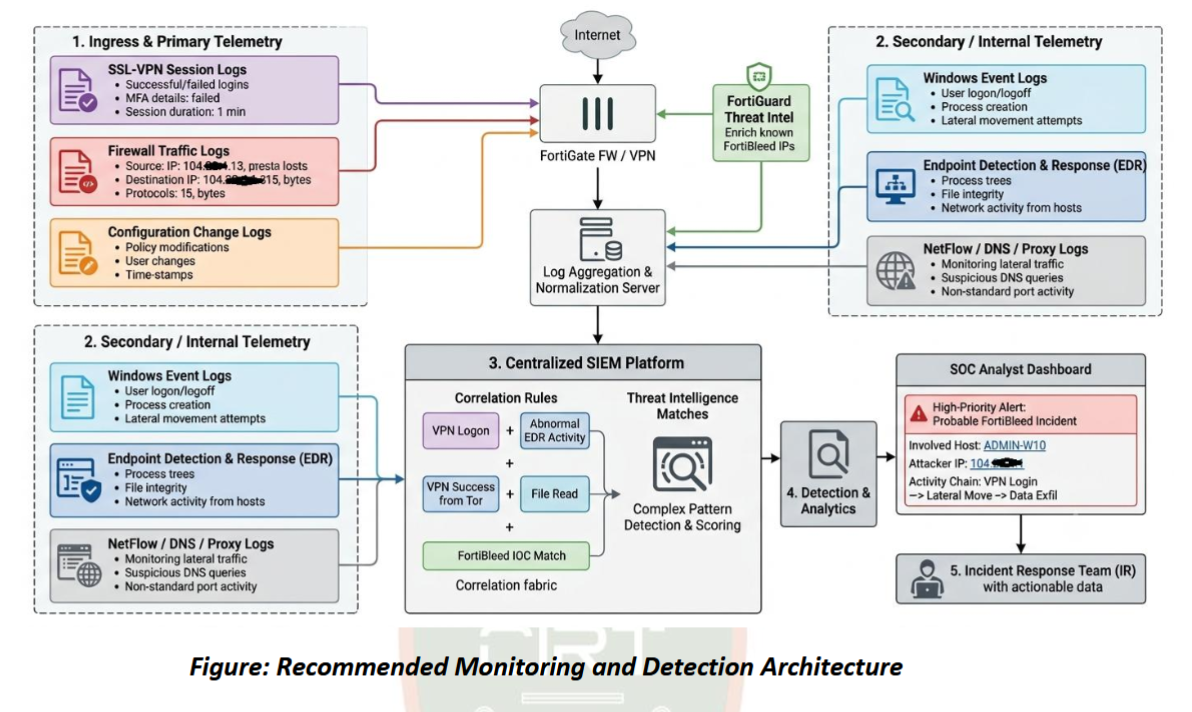
Organizations should implement continuous monitoring of FortiGate appliances, authentication systems, and Active Directory environments to identify indicators associated with credential compromise, unauthorized remote access, and post-exploitation activities linked to the FortiBleed campaign. Security teams should correlate firewall telemetry, VPN authentication logs, endpoint events, and network traffic to detect abnormal behaviors that may indicate successful exploitation or credential abuse.
FortiGate Device Monitoring
Monitor unauthorized administrator logins, configuration changes, firmware updates, configuration exports, and abnormal authentication activity.
SSL-VPN Authentication Monitoring
Detect VPN logins from unusual locations, impossible travel, concurrent sessions, dormant account usage, and repeated failed logins followed by successful authentication.
Active Directory Monitoring
Monitor domain enumeration, LDAP queries, Kerberos events (4768, 4769, 4771), privileged account changes, Group Policy modifications, and abnormal authentication activity).
References:
· Fortinet PSIRT – Analysis of Reported Credential Compromise of FortiGate Devices https://www.fortinet.com/blog/psirt-blogs/analysis-of-reported-credential-compromise-of-fortigate-devices
· Arctic Wolf – Active FortiBleed Campaign Impacting Fortinet Devices Across 194 Countries https://arcticwolf.com/resources/blog/active-fortibleed-campaign-impacting-fortinet-devices-across-194-countries/
· Dataprise – FortiBleed: What Fortinet Customers Need to Know https://www.dataprise.com/resources/blog/fortibleed-what-fortinet-customers-need-to-know/
· Microsoft – Kerberos Authentication Technical Documentation https://learn.microsoft.com/windows-server/security/kerberos/