AI-Branded Social Engineering, Phishing, and Malware Delivery Campaigns
Published on 09-Jul-2026 11:00:00
Executive Summary
Threat actors are increasingly abusing the branding of popular AI services as social-engineering bait to drive phishing, credential theft, payment fraud, and malware delivery. Microsoft reported campaigns using the names and visual branding of ChatGPT, Claude, DeepSeek, Microsoft Copilot, and other AI tools to make malicious messages, download pages, and repositories appear trustworthy and timely.
The activity spans several delivery models, including phishing emails with urgent account or billing themes, adversary-in-the-middle token theft flows, malvertising chains that push users to fake downloads, and SEO-driven discovery of malicious GitHub repositories. Microsoft assessed that the observed incidents reflected abuse of trusted brand names as lures rather than compromise of the legitimate AI vendors themselves.
This threat is directly relevant to Bangladesh because the observed activity already affected in South Asia, while the lures depend on user curiosity, urgent billing prompts, cloud-hosted redirects, and fake software downloads that are equally plausible against Bangladeshi government staff, students, freelancers, software users, and mobile-first internet users. The campaigns are therefore best understood as transferable social-engineering playbooks that can be quickly localized to Bangla or English and reused against Bangladeshi targets with minimal attacker effort.
Bangladesh Impact
Bangladeshi users are at realistic risk in at least four scenarios.
First, individuals who use AI services for study, coding, translation, graphics, or office productivity may respond to fake subscription, appeal, or access-restoration messages because the lures imitate normal service workflows.
Second, users searching online for “free” or “downloadable” AI tools, browser plugins, cracked software, or model installers may be exposed to malicious GitHub repositories, SEO-manipulated pages, and malvertising chains similar to those described by Microsoft.
Third, government officials, university staff, financial-sector employees, outsourcing professionals, and software developers in Bangladesh may face elevated exposure because these roles regularly open email attachments, use cloud identities, and rely on remote collaboration platforms where token theft can lead to mailbox compromise, business email compromise, and unauthorized data access.
Fourth, widespread use of personal Windows devices in home, education, and small-business environments increases the likelihood that fake installers or archive files will be executed outside centrally managed enterprise controls.
The campaign's activity in the South Asian region indicates that Bangladeshi users could also be targeted with minimal localization, such as Bengali content, local brands, or region-specific lures delivered through email, messaging applications, or social media. Potential impacts include payment card theft, credential compromise, AiTM-based session hijacking, infostealer infections (e.g., Vidar), account takeover, unauthorized access to government and financial services, data leakage, malware propagation, and reputational damage through the misuse of compromised accounts.
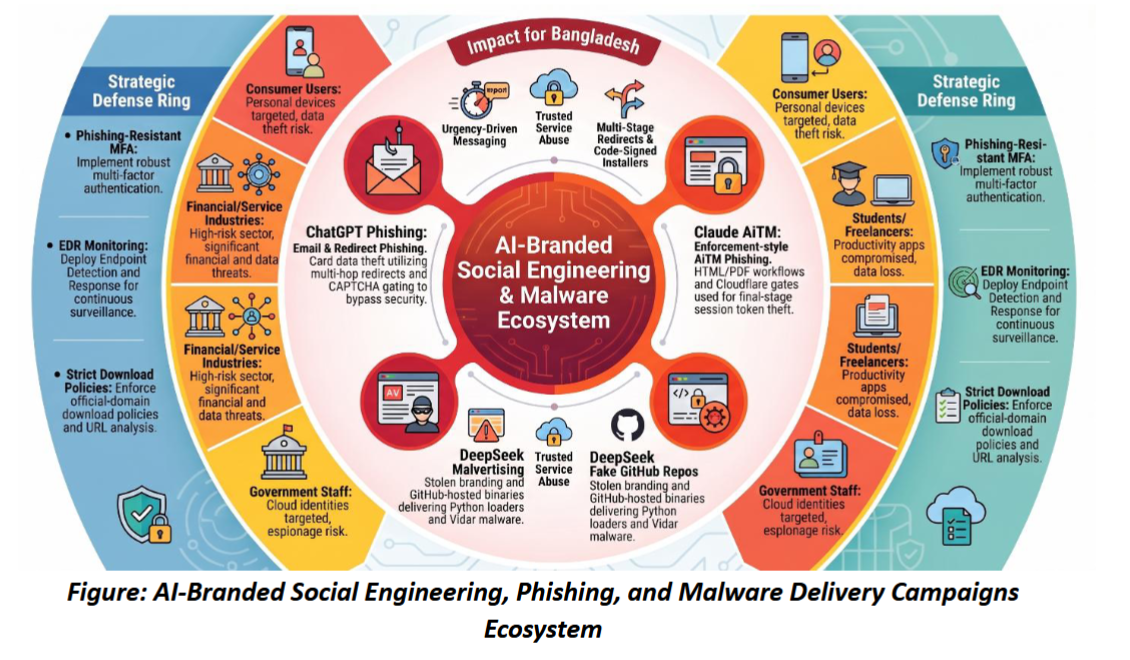 Threat Overview
Microsoft reported that threat actors are operationalizing public interest in AI as a durable social-engineering theme, combining curiosity and urgency with older but effective techniques such as spearphishing links, malicious attachments, redirector chains, and staged credential harvesting. The observed campaigns led to collection of payment card data, theft of credentials and access tokens, and delivery of malware including Vidar Stealer, Lumma Stealer, Hijack Loader, and Oyster. One cluster involved a ChatGPT-themed payment update lure, another abused Claude account-policy enforcement messaging for likely AiTM token theft, a separate campaign used an “Awesome AI Windows Plugin” malvertising lure to deliver a signed malware chain, and another used a fake DeepSeek V4 GitHub repository to distribute infostealer payloads. Microsoft linked part of the malware-distribution activity to Storm-3075 and described the use of malware-signing services attributed to Fox Tempest to increase trust and reduce early detection rates.
Campaign Details
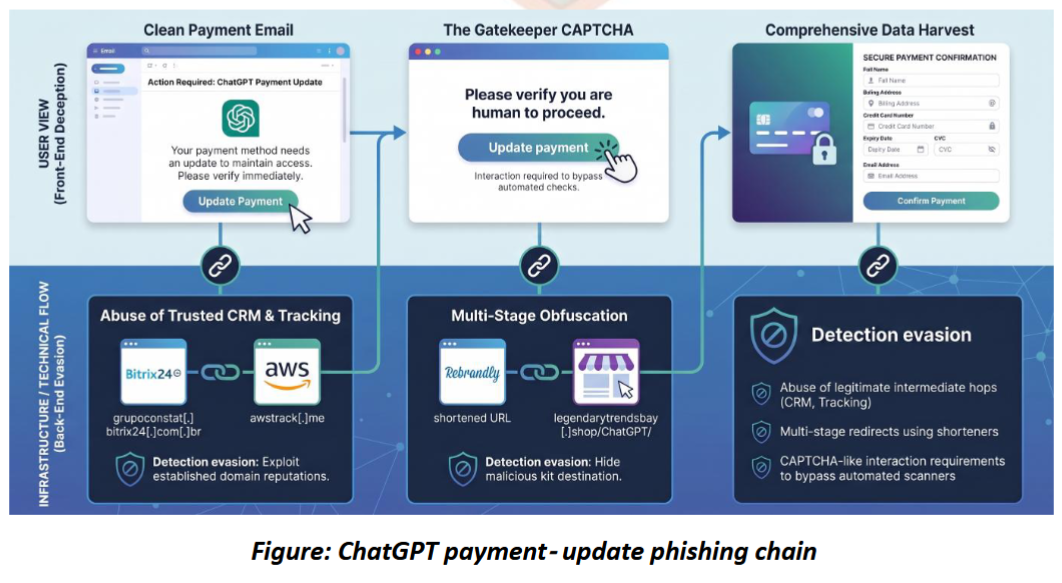
ChatGPT-themed phishing for card and personal data
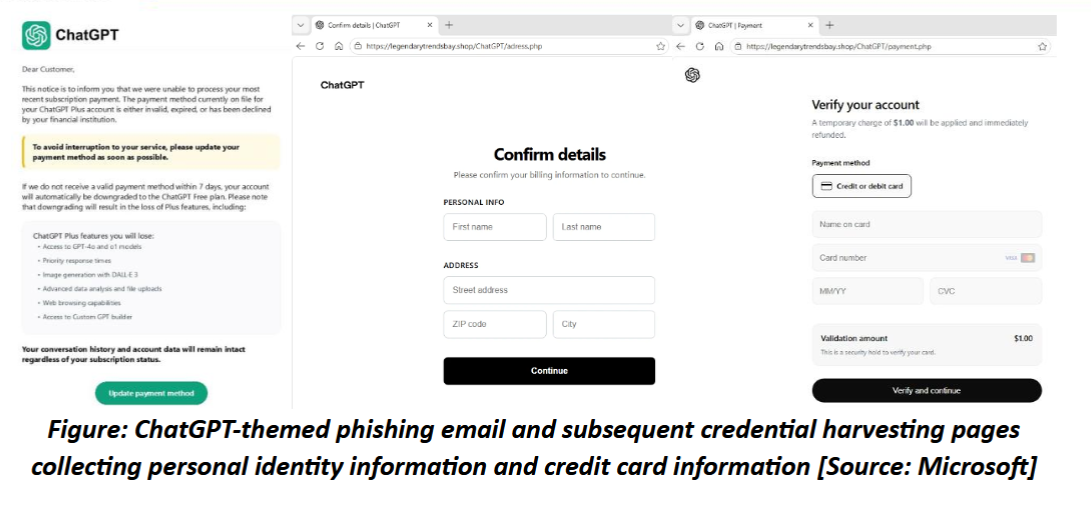
On 5 May 2026, Microsoft detected a ChatGPT-themed phishing campaign that sent malicious URLs leading to pages that collected personal and credit card information. Microsoft stated that 4,500 emails in one activity cluster targeted South Africa and that related activity delivered as many as 100,000 emails in a single day across multiple sectors including higher education and professional services.
The phishing email used the sender display name “ChatGPT” and the subject line “To ensure your ChatGPT Plus continues to work – please update your payment method”. The message warned that the account would be downgraded within seven days if payment details were not updated, a tactic designed to force hurried action before verification.
The redirection chain moved the victim through several legitimate or abused services before reaching the phishing kit: grupoconstat[.]bitrix24[.]com[.]br to awstrack[.]me to a Rebrandly URL and finally to legendarytrendsbay[.]shop/ChatGPT/. The final phishing site first displayed a custom CAPTCHA-like “Update payment” prompt and then collected the victim’s first name, last name, address, and credit-card details including expiration date and verification code.
Claude-themed phishing leading to likely AiTM token theft
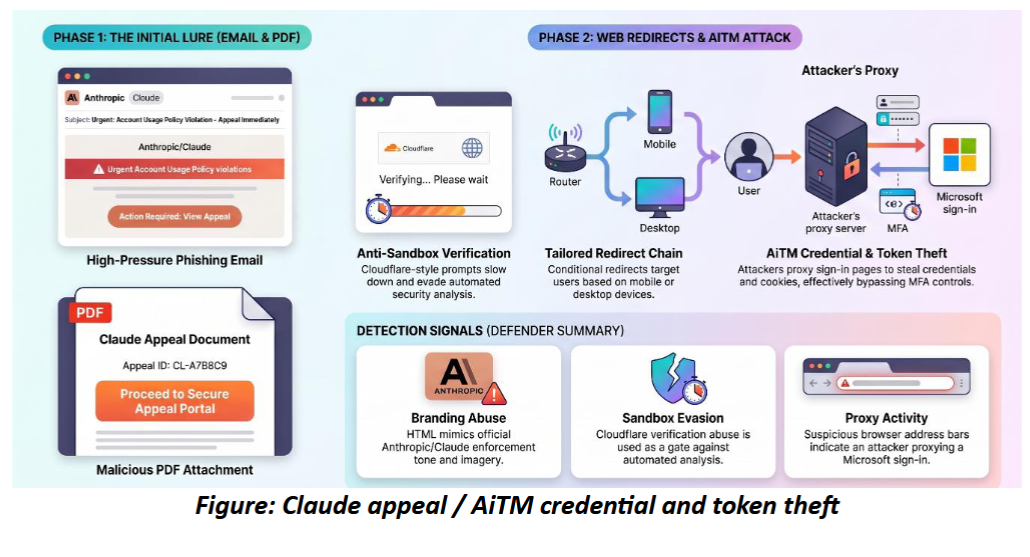
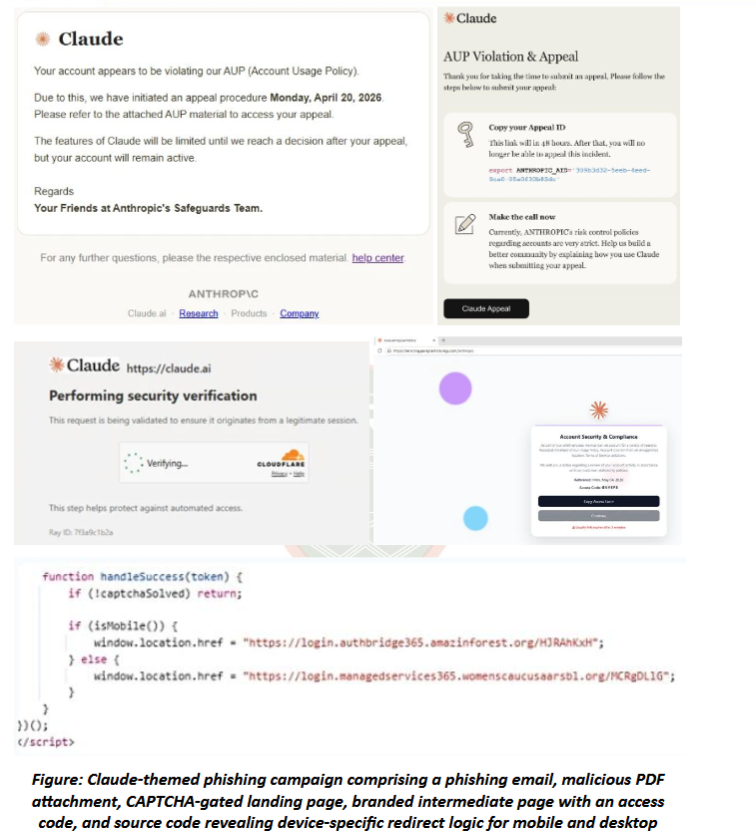
From 20 to 22 April 2026, Microsoft observed a campaign impersonating Anthropic-branded services and targeting more than 2,000 organizations, primarily in the United States (62%), the United Kingdom (18%), and India (9%). The campaign was especially concentrated in information technology (56%), other business entities (21%), and financial services (8%).
The messages used display names such as “Anthropic Teams” and “Anthropic PBC” and claimed the recipient’s account violated acceptable-use policy and required immediate appeal action. The email body was delivered as HTML, carried Claude branding, and instructed recipients to review an attached PDF named Fill and Sign Claude Appeal Form.pdf.
That PDF told the user to copy an appeal ID and click a “Claude Appeal” link, which led to dash.awaydouble[.]org. The initial landing page displayed a Cloudflare verification prompt, then redirected to servicing.pureplantcravings[.]com, which showed an “Account Appeal Notice” and a one-time access code before steering the victim toward a final sign-in experience consistent with adversary-in-the-middle token interception; Microsoft noted the redirect logic differed for mobile and desktop users.
“Awesome AI Windows Plugin” malvertising
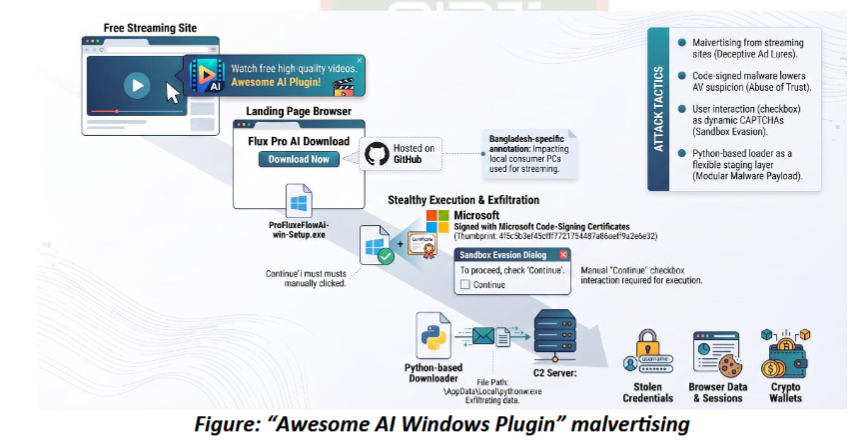
Since at least early 2026, Microsoft observed malvertising campaigns using AI-themed terms such as “Awesome AI Windows Plugin” and “Flux Pro AI” in popup lures, malware filenames, and GitHub repository paths. Microsoft described these campaigns as moving from launch to mass impact within hours and noted that a single campaign run on 13 March 2026 targeted more than 66,000 devices.
Telemetry showed global distribution, with the top affected countries including Japan, South Africa, the United States, and France, and Microsoft assessed that most impacted devices were likely consumer endpoints because the attack traffic originated from free movie streaming activity. The infection flow began when users clicked popups or interacted with embedded players on streaming sites and were then redirected to a page promoting a fictitious “Awesome AI Windows plugin” download.
Victims were prompted to retrieve ProFluxeFlowAi-win-Setup.exe from a GitHub repository named shippingtechnologymovie in the AI-techVideos path. The executable was signed with a fraudulently obtained Microsoft-issued code-signing certificate with thumbprint 4f5c5b3ef45cfff7721754487a86aeff9a2e6e32; after launch, it displayed a “Continue” checkbox, then dropped pythonw.exe and LICENSE.txt into *\AppData\Local*, executed shellcode, contacted brokeapt[.]com, and delivered Vidar infostealer.
Microsoft further stated that signed malware tends to achieve lower detection rates early in the infection lifecycle and that the extra “Continue” click was likely intended to defeat automated sandbox analysis because the binary remained inert until the user interacted with it. These details are important for Bangladeshi defenders because users often interpret signed executables, GitHub hosting, and familiar brand names as indicators of legitimacy.
Fake DeepSeek V4 GitHub repository distributing infostealers
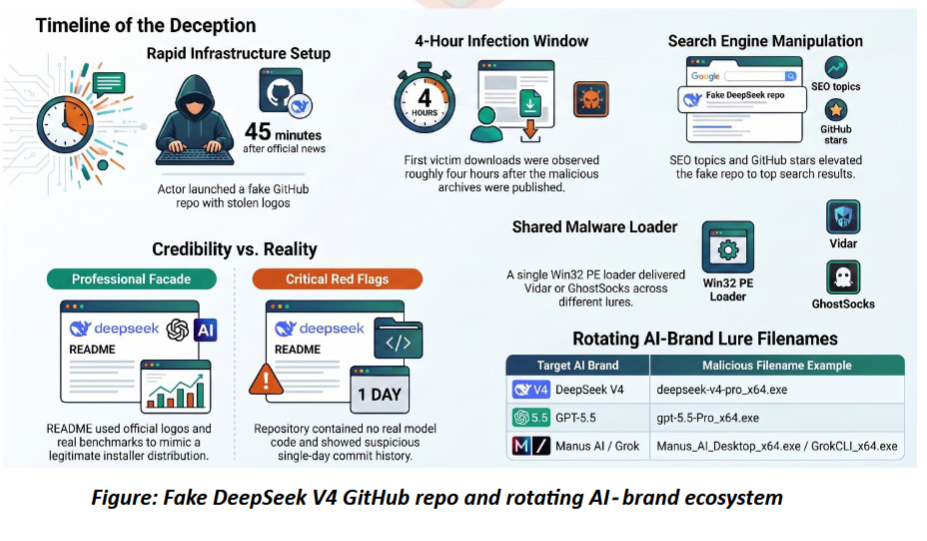
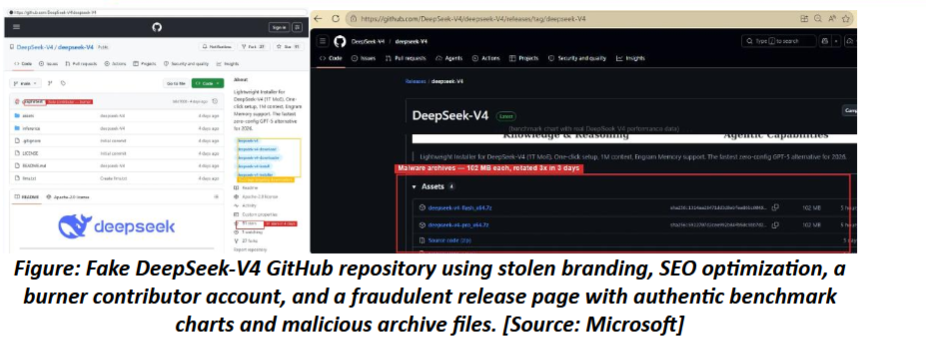
In April 2026, Microsoft identified a fake DeepSeek V4 GitHub organization and repository that abused interest in a newly previewed model to distribute malware through GitHub release assets. Microsoft reported that within hours of the official preview, the threat actor created the GitHub organization DeepSeek-V4, the repository deepseek-V4, and the release tag deepseek-V4, then decorated the repository with stolen branding, real benchmark data, and SEO-optimized topics.
The release page hosted malicious archives such as deepseek-v4-pro_x64.7z and deepseek-v4-flash_x64.7z. Microsoft stated that users could discover the repository via GitHub search, web search, social sharing, and AI-assisted search results, aided by topic tags like deepseek-v4-install and an llms.txt file that repeated installer-oriented SEO language.
The archives contained a loader, including SHA-256 5455341ed1bbe75a664fca2dd0794c508e1874f75360253a7ff5bc119bc92d80, which Microsoft observed downloading and installing Vidar and potentially other malware. Microsoft also noted that the operator rotated archive content while preserving filenames and reused the same shared loader across lures that impersonated GPT-5.5, Claude Code, Kimi, Seedance, Gemma, GrokCLI, Manus AI, and FraudGPT, indicating a broader rotating brand-abuse ecosystem rather than a single DeepSeek-only campaign.
Microsoft observed that the repository accumulated 91 stars and 27 forks within four days, though the authenticity of that engagement was not independently confirmed. On closer review, the repository contained only superficial project materials such as README, LICENSE, llms.txt, and stub directories without real model code, and it showed inconsistent licensing claims and bursty commits from a single author, all of which are practical analytic clues for defenders and users reviewing suspicious repositories.
Detection Opportunities
For Bangladesh, the highest-risk overlap is the combination of cloud identity use, unmanaged personal devices, interest in AI tools, and dependence on email and browser-based workflows. That mix makes both public-sector and consumer users vulnerable to the same tactics, even when the original campaign was first observed in another country.
- Monitor for AI-branded emails using billing, policy-violation, or appeal language, especially messages that create urgency with phrases such as payment update, account suspension, or policy review.
- Flag emails whose primary call-to-action is a button or link that chains through multiple domains, including CRM services, email-tracking domains, and URL shorteners before resolving to a final destination.
- Detect PDF attachments referencing AI services that instruct users to copy appeal IDs, verification codes, or account references and then click embedded links to unknown domains.
- Apply time-of-click URL inspection and link detonation to uncover late-stage redirects such as Bitrix24 to awstrack[.]me to Rebrandly to a compromised phishing host.
- Hunt in DNS, proxy, firewall, and EDR telemetry for communications with known malicious infrastructure, including dash.awaydouble[.]org, servicing.pureplantcravings[.]com, brokeapt[.]com, pan.ssffaa19[.]xyz, and pan.rongtv[.]xyz.
- Alert on execution of newly downloaded AI-themed installers or archives from Downloads, Desktop, Temp, or other user-writable paths, especially when execution follows web browsing or GitHub release downloads.
- Detect suspicious creation and execution of pythonw.exe, script files, or text files such as LICENSE.txt inside *\AppData\Local*, followed by shellcode-like behavior or unexpected outbound network activity.
- Monitor for sign-in anomalies associated with AiTM activity, including impossible travel, unfamiliar IP addresses or devices, sudden session-token reuse, and rapid mailbox or cloud-app access after a phishing event.
- Review GitHub downloads and developer workflows for installer-style archives or binaries from repositories that use strong branding and marketing text but provide little or no legitimate source code.
- Prioritize hunting for shared malware pivots, including the loader hash 5455341ed1bbe75a664fca2dd0794c508e1874f75360253a7ff5bc119bc92d80 and the code-signing certificate thumbprint 4f5c5b3ef45cfff7721754487a86aeff9a2e6e32, because Microsoft linked them to broader AI-themed malware-delivery activity.